
Your files are in folders. Your contacts are in a spreadsheet. Your calendar is color-coded, your inbox is sorted, and you can find any document in under a minute.
You’re organized. And your business is still falling behind.
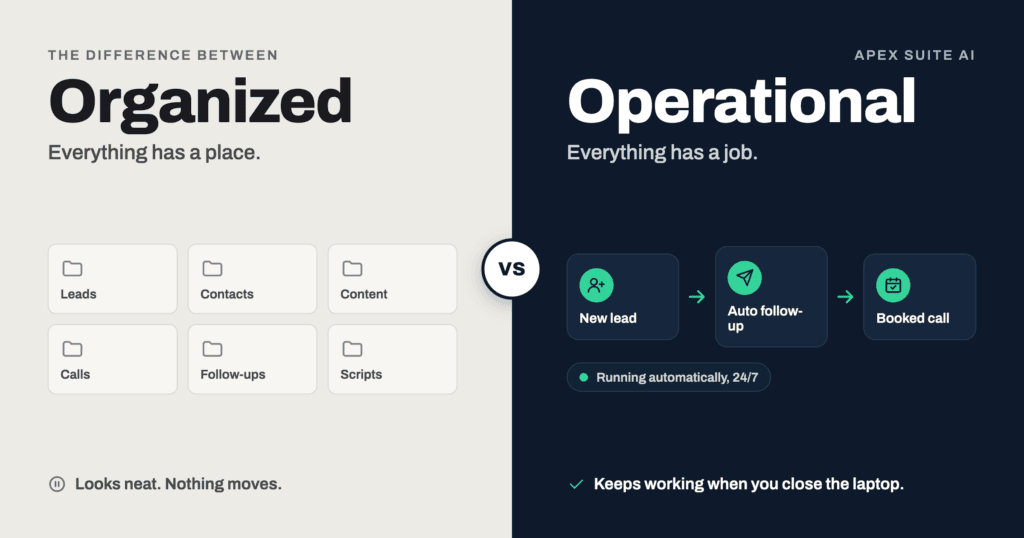
Organized means everything has a place. Operational means everything has a job. The difference matters more than most business owners realize, because the feeling of being organized is so satisfying that it masks the fact that nothing is actually moving.
A labeled folder doesn’t send follow-ups. A sorted contact list doesn’t know which lead went cold yesterday. A color-coded calendar doesn’t remind your team what happened in last week’s call. Organization is a filing system. Operations is a living one.
Most platforms sell organization and call it operations. They give you dashboards, tags, filters, and folders. They make your data neat. And then they wait for you to do something with it. The moment you stop touching the system, the system stops working.
What operational actually looks like is harder to see from the outside, because the best version of it is invisible. Follow-up fires without you scheduling it. A new lead enters the system and the system already knows what to do. Content is ready when you are, not because you remembered to prepare it, but because the preparation is built into how the platform behaves.
Operational doesn’t mean you disappear from your business. It means the business doesn’t disappear the moment you step away. The follow-ups still go out on Thursday. The lead who filled out a form on Saturday still gets contacted on Monday morning. The team member who joined last week still has access to the same scripts and resources as the person who’s been there six months.
That’s the gap between organized and operational. One looks good from the inside. The other works whether anyone is looking or not.
When a platform is built so that the CRM, the follow-up, the content, and the team coordination share the same architecture, the shift from organized to operational stops being a discipline problem and starts being a default. That’s the design philosophy behind Apex Suite AI. Not a filing system you maintain, but an operating system that maintains the work.
The question worth sitting with: is your business organized, or is it operational? Because only one of those keeps running when you close the laptop.