
A lead called you three weeks ago. They asked about pricing, mentioned they were comparing two other options, and said they’d circle back after a board meeting.
Quick – what was their name? Which options were they comparing? When was the board meeting?
If you had to check four different places to answer those questions, your business has a memory problem.
Most businesses don’t forget things because people are careless. They forget things because information lives in too many places. The call notes are in one app. The email thread is in another. The form submission is in a third. The follow-up reminder – if one exists – is somewhere else entirely.
Each of those places remembers its own piece. None of them remembers the whole picture. So every time you pick up a conversation with a lead or a customer, you’re starting from fragments instead of context.
That’s not a memory problem in the human sense. It’s an architecture problem. The system was never designed to remember across features – it was designed to remember within them.
The cost of fragmented memory shows up in small moments that compound. A follow-up email that doesn’t reference the last conversation. A team member who asks a lead to repeat something they already told someone else. A missed callback because the reminder was in one system and the contact details were in another.
None of those moments feels catastrophic on its own. But each one tells the lead something: this business doesn’t remember me. And a lead who feels forgotten doesn’t stay a lead for long.
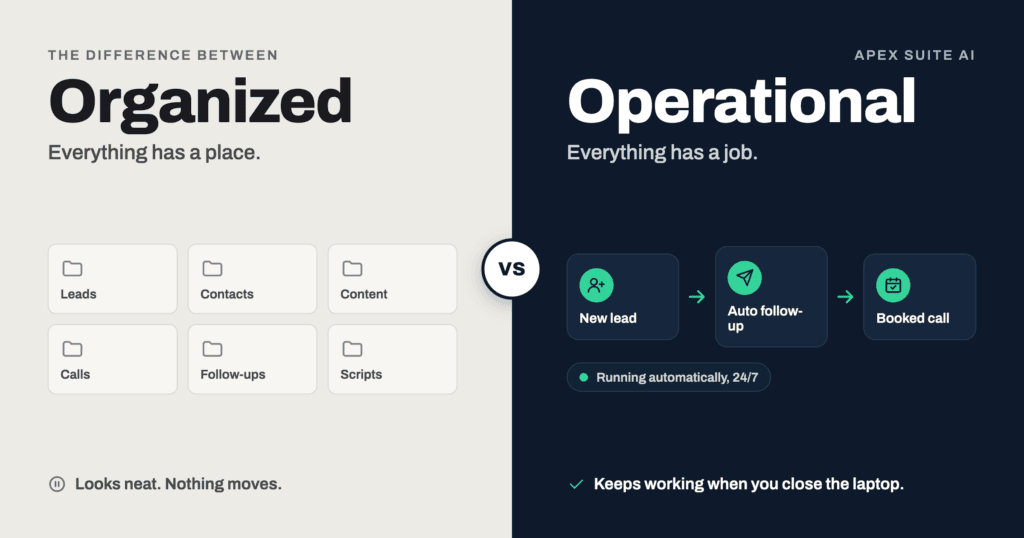
The businesses that retain attention – and retention is what converts – are the ones where every touchpoint carries context from the last one. Not because someone manually transferred notes between apps, but because the system was built so that information flows between features instead of sitting in silos.
That’s what a connected architecture actually does. It doesn’t just store data. It makes data available at the moment it’s relevant, in the feature where it’s relevant, without anyone having to go find it.
Your business doesn’t have a people problem. It has a memory problem. And the fix isn’t better note-taking habits. It’s an architecture that remembers on your behalf, across every feature, every time.