Every software company says their platform integrates with everything. Hundreds of connections. Thousands of apps. A marketplace full of plug-ins.
What almost nobody says is what happens inside those integrations when something goes wrong. Because that’s where “integrated” and “built-in” stop meaning the same thing.
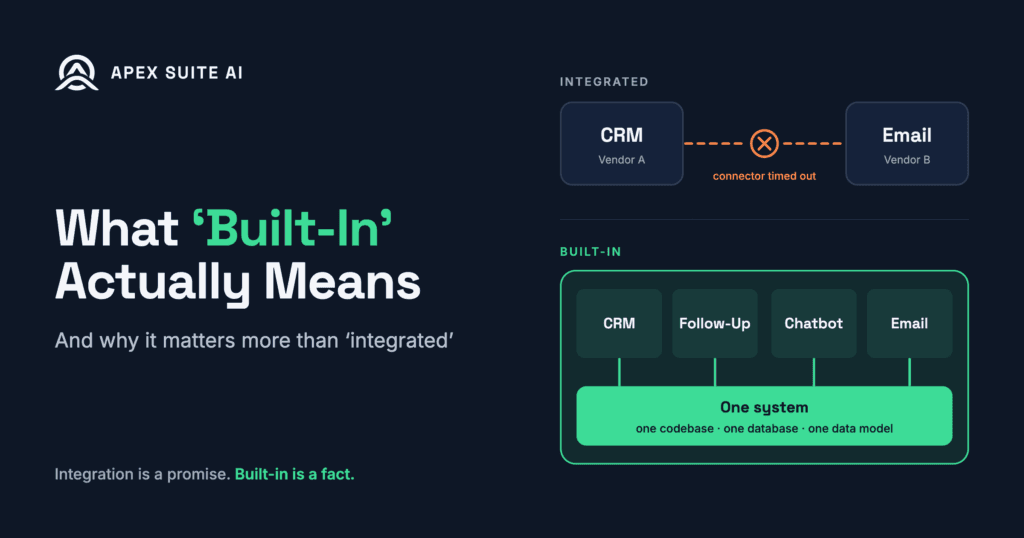
Integrated means two separate systems are connected by a bridge. Data passes from one to the other through an API, a webhook, or a third-party connector. When it works, it feels seamless. When it breaks – and it will break – you’re troubleshooting across two systems that were never designed to work together, with a middleman connector that may or may not log what went wrong.
Built-in means the features share the same architecture from the ground up. There’s no bridge because there’s no gap. The CRM, the follow-up, the email, the landing pages, the content library – they were built in the same codebase, on the same database, with the same data model. When data moves from one feature to another, it doesn’t leave the system. It’s already there.
That distinction matters more than most buyers realize, because it’s invisible when things are working. The difference shows up when they’re not.
When an integration breaks, the first question is: whose problem is it? The CRM vendor says the data was sent correctly. The email platform says it never received it. The connector says the webhook fired but the response timed out. You’re now the project manager of a debugging effort across three companies, none of which built their product to work with the others.
When a built-in feature has an issue, it’s one system, one support team, one data layer. The diagnosis is faster because the surface area is smaller. The fix is faster because nobody has to coordinate across vendors.
Apex Suite AI was built on this principle. The Smart CRM, the 15-Point Follow-Up, the AI Sales Chatbot, the content features, the team coordination – they don’t integrate. They coexist. A lead who enters through the chatbot carries their conversation history into the CRM. A follow-up sequence pulls context from the lead’s profile. A team member sees everything in one place because everything was built to share one place.
That’s not a feature advantage. It’s an architecture advantage. And architecture is the thing that determines whether the features hold up under real use or fall apart when the volume increases.
The next time a platform tells you it integrates with everything, ask a different question: what’s built in? Because integration is a promise. Built-in is a fact.